Have an emergency? Call us now on 07732 234231. Available 24/7 with a 30 minute response time.

TL;DR:
- Hampshire’s hard water causes rapid limescale build-up, reducing boiler efficiency and increasing costs.
- Regular professional descaling prevents damage, maintains efficiency, and complies with warranties and regulations.
- Annual or biannual descaling by qualified engineers is recommended for property owners in hard water regions.
Most homeowners only think about boiler descaling when something goes wrong. That’s a costly mistake. Limescale builds silently inside your heating system, reducing efficiency and pushing up energy bills long before any breakdown occurs. In Hampshire, where hard water is the norm, this problem is worse than most people realise. This guide explains exactly what boiler descaling involves, why it matters for your home or rental property, which methods work best, and how often you should be doing it. By the end, you’ll have a clear, practical picture of how to protect your heating system and avoid unnecessary expense.
| Point | Details |
|---|---|
| Prevent costly breakdowns | Descaling regularly avoids expensive boiler failures and extends lifespan. |
| Boost energy efficiency | Removing limescale helps your boiler work harder for less money. |
| Choose the right method | Select chemical, ultrasonic, or mechanical descaling based on your boiler’s needs. |
| Trust local professionals | Professional servicing ensures safe, thorough cleaning and protects your warranty. |
Boiler descaling is the process of removing limescale and mineral deposits that accumulate inside your boiler and heating system over time. Limescale is a hard, chalky substance made up mainly of calcium carbonate. It forms when hard water is heated, causing dissolved minerals to crystallise and stick to metal surfaces.
Hampshire sits in one of the hardest water regions in England. Areas like Portsmouth, Waterlooville, and Fareham receive water with high mineral content, which means limescale builds up faster than in softer water regions. The parts most affected are the heat exchanger (the component that transfers heat from the burner to your water), internal pipework, and valves. When these surfaces coat with scale, heat transfer becomes less efficient and water flow is restricted.
Here’s what the descaling process typically involves:
For most domestic properties, descaling a combi boiler involves isolating the heat exchanger, circulating an acidic solution via pump for 45 to 60 minutes, then flushing the system clean. The whole visit typically takes between one and two hours depending on the severity of the scale and the size of the system.
Worth knowing: Descaling is not the same as a full power flush. A power flush cleans the entire central heating circuit, including radiators, whereas descaling focuses specifically on the boiler’s internal components.
Understanding the boiler service steps involved in a professional visit helps you know what to expect and ask the right questions when booking.
With the basics covered, let’s see why this should matter for every heating system in Hampshire.
Hampshire’s water hardness is a genuine problem for heating systems. The region consistently records high levels of temporary hardness, meaning every litre of hot water your boiler processes deposits a tiny amount of scale. Over months and years, that adds up to a significant layer of insulation inside your heat exchanger, and not the good kind.

Limescale left untreated can dramatically reduce efficiency and lead to costly repairs. A 1mm layer of scale on a heat exchanger surface can reduce its efficiency by up to 7%. A 5mm layer can cut efficiency by as much as 20%. That translates directly into higher gas bills every single month.
Here are the most common problems caused by limescale build-up:
Pro Tip: If your boiler is making a low rumbling or banging sound during operation, that is almost always kettling caused by limescale. Don’t ignore it. The longer you leave it, the more damage accumulates.
Knowing the signs you need boiler repair early gives you the chance to act before a minor issue becomes a major expense. Equally, understanding servicing frequency advice helps you build a maintenance routine that keeps limescale from ever becoming a serious problem.
For property managers overseeing multiple homes in Hampshire, the financial case is even stronger. A boiler running at reduced efficiency across several properties adds up to a significant and entirely avoidable cost each year.
Understanding its importance, the next step is knowing your cleaning options.
There are three main approaches to boiler descaling, and each suits different situations. Choosing the right one depends on the severity of the scale, the type of boiler, and whether you’re dealing with a domestic or commercial system.
| Method | How it works | Best for | Key drawback |
|---|---|---|---|
| Chemical | Acidic solution circulated through the system | Moderate to heavy scale | Risk of corrosion, some downtime |
| Ultrasonic | High-frequency sound waves break up scale | Mild scale, prevention | Higher upfront cost |
| Mechanical | Physical brushing or scraping of surfaces | Severe blockages | Can scratch heat exchangers |
Here’s a closer look at each:
Chemical descaling is the most widely used method for domestic boilers. An acidic solution is pumped through the system to dissolve mineral deposits. It’s fast and thorough, but chemical methods carry a risk of corrosion and require system downtime, so they should always be carried out by a qualified engineer.
Ultrasonic descaling uses high-frequency vibrations to break apart scale without any chemicals. It’s gentle on components and produces zero downtime, but it works best as a preventative measure rather than a cure for heavy build-up.
Mechanical descaling involves physically removing scale using brushes or scrapers. It’s reserved for severe cases where chemical methods alone won’t shift the deposits, but it carries a real risk of scratching or damaging heat exchanger surfaces if not done carefully.
Pro Tip: For most Hampshire homeowners, chemical descaling carried out annually by a Gas Safe registered engineer is the most practical and cost-effective choice. Ultrasonic methods are worth considering if you want to reduce chemical use or have a newer system you want to protect proactively.
For a broader view of what local professionals offer, it’s worth comparing local boiler servicing options before committing to a provider.
Once you’ve picked a method, timing and expertise are the next big questions.
For Hampshire properties, annual or biannual descaling intervals are typically optimal given the region’s hard water, though property age and usage patterns affect the ideal timing. Here’s a practical guide:
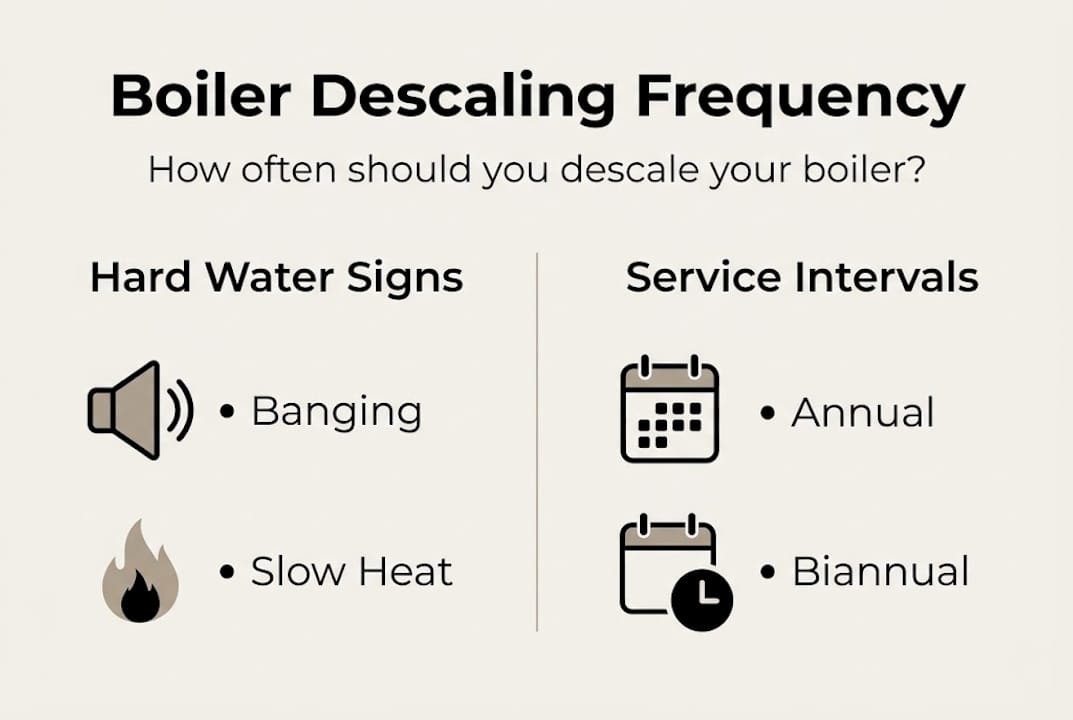
| Factor | Recommended interval |
|---|---|
| Hard water area (Hampshire) | Annually |
| Older boiler (10+ years) | Annually or biannually |
| Large household (5+ people) | Annually |
| Newer system with inhibitor | Every 2 years |
| Commercial or rental property | Annually as minimum |
Key factors that affect how quickly scale builds up include:
When it comes to who should carry out the work, a professional engineer brings far more than just the descaling itself. They’ll check for corrosion, test pressure, inspect seals, and confirm the system is operating safely. Attempting a full descale yourself without the right tools and training risks chemical burns, system damage, and potentially voiding your boiler warranty.
Pro Tip: Always ask your engineer to add a scale and corrosion inhibitor after descaling. It’s a small additional cost that significantly slows future build-up and protects your system between services.
For a full breakdown of what a professional visit covers, the annual boiler servicing steps guide is a useful reference. You can also find region-specific guidance in this boiler servicing in Hampshire overview.
Most articles on boiler descaling focus on the technical side and leave out the financial and legal picture. That’s a gap worth addressing.
The real cost of neglecting descaling doesn’t appear as a sudden breakdown. It shows up gradually in your energy bills, months before anything visibly fails. By the time your boiler stops working, you’ve already paid the penalty through wasted fuel. That’s the part most homeowners miss entirely.
There’s also an insurance and warranty angle that rarely gets mentioned. Many boiler manufacturers and home insurance policies include clauses requiring evidence of regular servicing and maintenance. If a claim is made and there’s no record of annual servicing, including descaling where appropriate, your cover could be invalidated. That’s a significant financial risk for something so preventable.
For property managers, the stakes are even higher. Regulatory compliance around heating system maintenance in rental properties is tightening. A documented maintenance record isn’t just good practice; it’s increasingly a legal expectation.
We’ve seen this pattern repeatedly over 18 years of work across Hampshire. The homeowners who invest in annual boiler servicing spend less overall, experience fewer emergencies, and keep their systems running far longer. Reviewing your boiler maintenance plans is a practical first step toward building that habit.
If you’ve read this far, you already understand that descaling is not a luxury or a reactive fix. It’s a routine part of keeping your heating system efficient, safe, and cost-effective.
At Skan Heating, we’ve been looking after boilers across Hampshire for over 18 years, and we know exactly what hard water does to heating systems in this region. Whether you need a one-off descale, a full service, or ongoing maintenance support, our Gas Safe registered engineers are ready to help. Explore our heating solutions or use our boiler installation checklist to plan ahead. You can also compare providers using our best plumbing services in Hampshire guide.
Even new boilers benefit from descaling in hard water areas like Hampshire, because hard water accelerates limescale build-up from the very first use. Starting a maintenance routine early protects efficiency and prolongs the system’s lifespan.
Minor scale on accessible components can sometimes be tackled at home, but a full descale requires isolating, circulating acidic solution, and flushing the system, which needs professional tools and training to do safely without voiding your warranty.
The clearest warning signs are banging or rumbling noises during operation, slow hot water, and a noticeable rise in your energy bills without a change in usage habits.
Ultrasonic methods are chemical-free with zero downtime and work well for prevention, but chemical descaling provides deeper cleaning for moderate to heavy scale and remains the most practical option for most domestic boilers.