Have an emergency? Call us now on 07732 234231. Available 24/7 with a 30 minute response time.

TL;DR:
- Regular boiler checks identify hidden faults, prevent safety hazards, and ensure compliance in Hampshire.
- Servicing improves energy efficiency, reducing heating bills by up to 15 percent annually.
- Local conditions like hard water and concealed flues make proactive maintenance essential in Hampshire.
Most homeowners and business owners in Hampshire only think about their heating system when it stops working. That’s a costly habit. The truth is, a boiler or central heating system that appears to run fine can still harbour dangerous faults, waste significant energy, and void your insurance cover. Annual boiler checks are not a luxury or a formality. They are one of the most straightforward ways to protect your property, your family or staff, and your wallet. This guide breaks down exactly why, with real evidence to back every claim.
| Point | Details |
|---|---|
| Prevents safety issues | Annual heating checks catch serious risks before they become dangerous or costly. |
| Boosts energy efficiency | Regular servicing directly lowers bills by improving system performance. |
| Protects property value | Documented checks support insurance claims and help maintain or increase home value. |
| Meets Hampshire needs | Hampshire’s hard water and older homes demand tailored maintenance beyond basic servicing. |
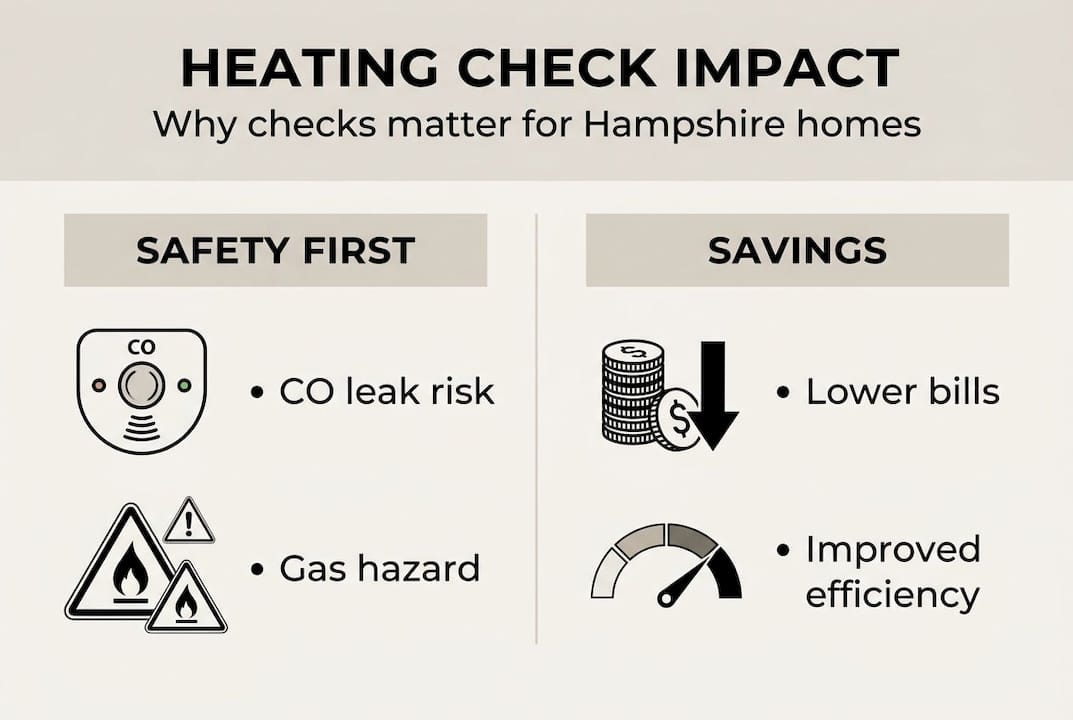
With the stakes this high, it is important to understand exactly why routine checks are strongly recommended. The most serious risk that regular servicing addresses is carbon monoxide poisoning. Carbon monoxide is colourless and odourless, which means you cannot detect it without specialist equipment. A cracked heat exchanger or a blocked flue can allow it to leak silently into your living space or workplace. Beyond this, gas leaks and faulty ignition components are among the leading causes of domestic fire incidents in the UK.
Regular heating checks by Gas Safe registered engineers are essential for detecting carbon monoxide leaks, gas leaks, and flue issues before they become hazardous. That single sentence covers a range of risks that a visual inspection by an untrained eye simply cannot address. A qualified engineer uses calibrated equipment to measure combustion gases, test flue integrity, and inspect internal components that are completely hidden from view.
For landlords and employers in Hampshire, the legal dimension is equally important. Landlords must ensure gas appliances are checked annually under the Gas Safety (Installation and Use) Regulations 1998, and failure to comply can result in prosecution. Employers under the Health and Safety at Work Act 1974 carry a duty of care that includes maintaining safe heating systems. These are not optional extras.
Here are the core risks that regular checks prevent:
“An annual boiler service is one of the most effective ways to protect the people inside a building. Faults that are invisible to the occupant can be identified and resolved before they escalate.” — Energy Saving Trust
Pro Tip: Keep a physical and digital record of every service carried out on your heating system. This protects your warranty, supports insurance claims, and is evidence of compliance if you are a landlord or business owner. It can also add demonstrable value if you sell the property.
Understanding why annual boiler servicing matters is the first step. Acting on it is the second.
Beyond peace of mind, regular checks have a measurable impact on what you spend each year. A boiler that has not been serviced accumulates limescale on its heat exchanger, soot on its burner, and pressure imbalances across the system. Each of these faults forces the boiler to work harder to deliver the same level of heat. That extra effort translates directly into higher gas bills.
Routine servicing can save 5 to 15% on heating bills each year, which works out to roughly £80 to £120 for an average UK household. For a business running a larger commercial system, the proportional savings are even greater. In Hampshire, where older housing stock and hard water compound the problem, those savings are very real.
“Keeping your boiler serviced and your heating system clean can meaningfully reduce energy consumption and keep your bills lower year on year.” — Energy Saving Trust
Here is what happens during a professional check to boost efficiency:
| Scenario | Estimated annual gas spend | With regular servicing |
|---|---|---|
| Hampshire home, no service | £1,400 | N/A |
| Hampshire home, annual service | £1,400 | £1,190 to £1,260 |
| Small business, no service | £4,200 | N/A |
| Small business, annual service | £4,200 | £3,570 to £3,780 |
Those figures reflect the kind of outcome you can expect when you invest in saving on heating bills through proactive maintenance rather than reactive repairs. Explore preventative maintenance tips to build a practical schedule that keeps your system running at its best throughout the year.

Knowing the benefits is helpful, but understanding the actual service steps puts you in control. When a Gas Safe registered engineer arrives to carry out your annual heating check, there is a defined sequence of inspections and tests that should take place. Knowing what these are means you can spot immediately if a quick visual glance is being passed off as a full service.
A thorough check includes the following steps:
These service mechanics including pressure checks, flue testing, heat exchanger cleaning, and inhibitor dosing are defined under BS 7593, the British Standard for treatment of water in heating systems. An engineer who skips these steps is not completing a full service, regardless of what they charge.
| Task | DIY (safe for homeowners) | Gas Safe engineer only |
|---|---|---|
| Bleeding radiators | Yes | No |
| Checking system pressure gauge | Yes | No |
| Topping up pressure via filling loop | Yes (with guidance) | No |
| Combustion analysis | No | Yes |
| Flue gas testing | No | Yes |
| Gas valve inspection | No | Yes |
| Inhibitor dosing | No | Yes |
Pro Tip: After every service, ask your engineer for a written report listing every item checked and the result. This is not just good practice; it is your evidence that the work met the required standard. The annual maintenance process should always end with documentation, not just a verbal confirmation. Understanding the role of a Gas Safe engineer helps you ask the right questions and set the right expectations.
While the main service is universal, certain local conditions and less common system types require special attention. Hampshire presents a specific set of challenges that go beyond what a standard annual check is designed to address by default.
Hampshire’s water supply sits in a hard water zone, meaning calcium and magnesium deposits accumulate in pipework and on heat exchangers more rapidly than in softer water areas. Without regular inhibitor dosing, this scale can reduce boiler efficiency significantly and shorten the lifespan of key components. Checking water quality and system risks is therefore not a peripheral concern for Hampshire properties. It is a priority.
Less obvious risks include:
“Flues in voids present a significant risk if they cannot be properly inspected. Landlords and property managers must ensure appropriate access is available for flue checks.” — Health and Safety Executive
For businesses in Hampshire, edge cases including flue voids and redundant back boilers can create serious legal liability if discovered after an incident. The HSE is clear that ignorance is not a defence.
Warning signs that mean you need more than a standard check include unexplained increases in gas bills, pilot lights that keep going out, discolouration around the boiler casing, or persistent cold spots in radiators. Refer to our heating system troubleshooting guide if any of these apply to your property.
It is one thing to understand the recommendations. It is another to see the fuller local picture. After more than 18 years working in Hampshire homes and businesses, one pattern stands out clearly: the customers who end up with the most expensive and disruptive problems are almost always the ones who waited.
Waiting for a breakdown guarantees a reactive repair bill, often in the coldest months when engineers are busiest and parts take longer to source. But the less visible cost is the energy waste that builds up quietly over months or years. A boiler losing even 8% efficiency because it has not been cleaned is draining money steadily, and the owner has no idea.
Hampshire’s older building stock makes this especially relevant. Many properties in Portsmouth, Waterlooville, and the surrounding villages still run on systems installed 15 or more years ago. These are not bad systems, but they need consistent care. Hard water accelerates wear. Seasonal properties, such as holiday lets along the Hampshire coast, face the added risk of standing water in pipes during warmer months, which corrodes from the inside out.
Property value and insurance cover are also increasingly tied to maintenance records. Buyers and surveyors now routinely ask for evidence of boiler servicing history. Insurers are becoming stricter about claims where no service history exists. Exploring energy efficiency in Hampshire homes from a long-term perspective reveals that a £100 annual service is not a cost. It is an investment that protects thousands of pounds in equipment, reduces running costs, and keeps your property compliant and insurable.
If this article has made one thing clear, it is that waiting for something to go wrong is the most expensive approach you can take with your heating system. Hampshire homeowners and business owners face real local risks, from hard water scale to concealed flues, that make proactive servicing even more important than the national average would suggest.

At Skan Heating, our expert heating engineers understand the specific conditions across Portsmouth, Waterlooville, and the wider Hampshire area. We carry out thorough Gas Safe inspections, provide full written reports, and offer practical advice tailored to your property type. Whether you want to review local heating solutions or follow our annual boiler service workflow, we make the process straightforward. Book your heating check today and take the reactive stress out of your heating for good.
At least once a year is the recommended frequency, with the work carried out by a Gas Safe registered engineer to meet best practice and safety requirements. Properties in hard water areas or with older systems may benefit from more frequent inhibitor checks.
Homeowners can safely bleed radiators, check the pressure gauge, and top up pressure via the filling loop, but all gas and combustion work must be handled by a certified Gas Safe engineer. Attempting gas-related tasks without the correct registration is illegal and dangerous.
Yes. Servicing optimises combustion and clears deposits that reduce efficiency, and the savings of 5 to 15% on annual heating costs are well documented. For most Hampshire households, that is between £80 and £120 back in your pocket each year.
Hard water accelerates limescale build-up in pipes and heat exchangers, requiring more frequent inhibitor dosing. Older properties may also have concealed flues or back boilers that present unique safety hazards requiring specialist inspection beyond a standard annual check.